Cloud Computing & Business Systems Workshop · Day 1
Build ChaiCart ☕☁️
Cloud Computing Fundamentals & Industry Practices
Today you are not students. You are founders.
Today’s agenda · 09:30–16:30
Day 1 — Build ChaiCart
Morning · 09:30–12:25
- Teams, roles & LinkedIn icebreaker
- What is cloud? Human Timeline
- IaaS / PaaS / SaaS
- Deployment models & Cloud Shark Tank
Afternoon · 13:15–14:45
- GitHub networking icebreaker
- Cloud Bingo, VMs & containers
- Azure VM/container demo
- Architecture Lego
Final session · 15:00–16:30
- Microservices & Human Kitchen
- Industry Gallery Walk
- Observability introduction
- Quiz & tomorrow’s cliffhanger
Breaks: 11:00 & 14:45 · Lunch: 12:25–13:15 · Networking: +100 credits per activity, per team
The mission · Build, operate, then pitch ChaiCart
One workshop. Three places to work.
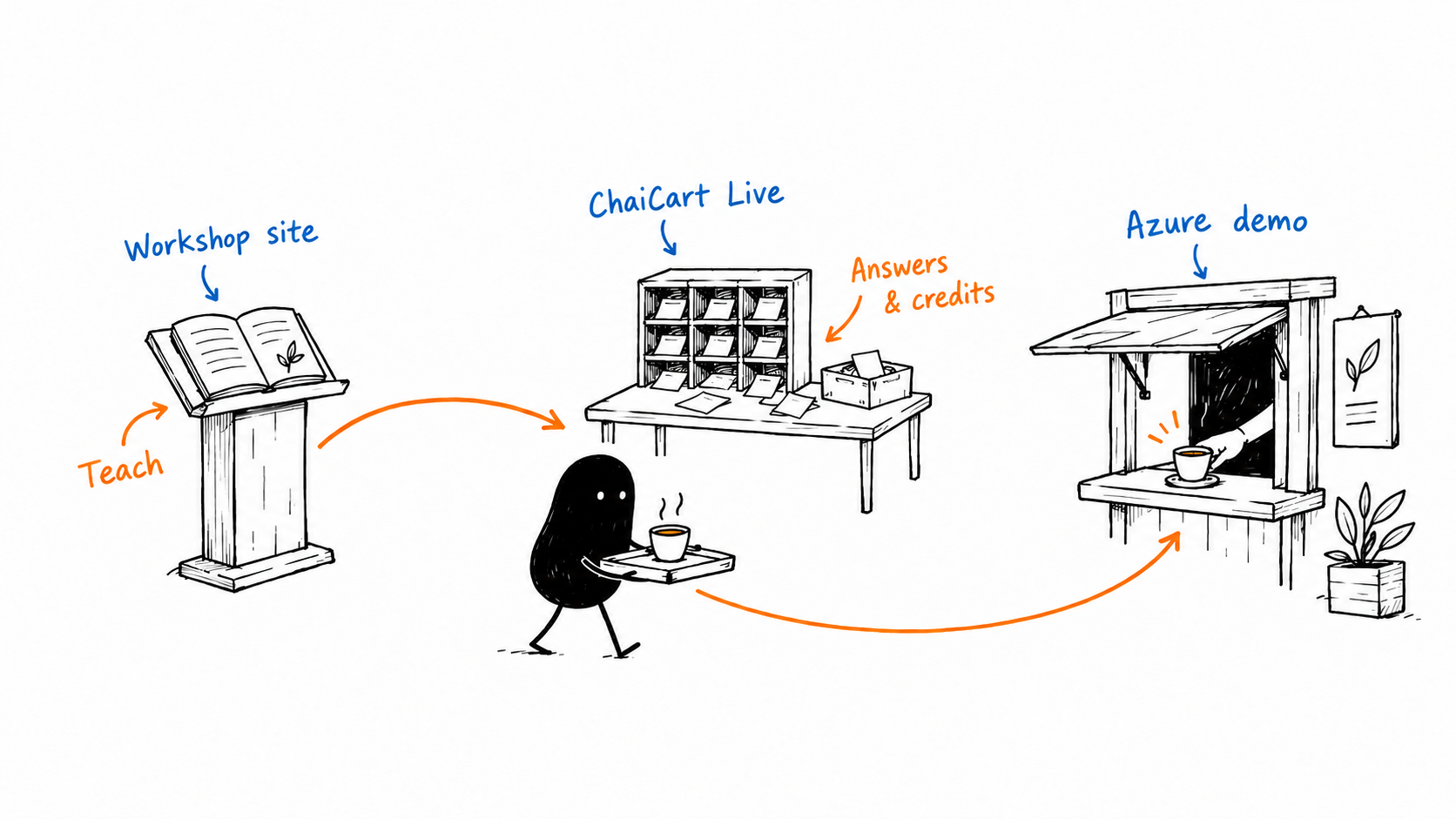
Workshop site: slides, notes and the flow map.
ChaiCart Live: Google sign-in, team answers and official credits.
Azure demo: simulated orders, outages and recovery.
Day 1: design your startup. Day 2: keep it alive. Finale: your 3-minute pitch.
Start with 1,000 Cloud Credits. Open the illustrated project guide ↗
How we play
120 founders. 24 startups. 4 regions.
- Every team of 5 is an Availability Zone, e.g. Mumbai-1a
- Six teams form a Region: West India, South India, Central India, North India
- Many games run inside your region first; region winners go to the main stage
- Win activities → earn credits. Outages, leaks, bad calls → lose credits
- Phones allowed for research, not reels
Awards at Demo Day
- Richest Startup (overall leaderboard)
- Region Champions (top team in each region)
- Sherlock Award (murder mystery)
- Best Architecture
- Best Blameless Postmortem
- Most Creative Pitch
ACTIVITY · 5 min
Pick your roles. Follow the handoff.
CEO · Decisions and pitches
CTO · Architecture and technology
SRE · Reliability and recovery
CFO · Costs and credits
COO · Time and shared team submissions
Sign in with Google, enter your captain’s team code, then claim one available role in Live.
Reviewed work: COO submits → captain reviews → captain or facilitator awards → ledger updates.
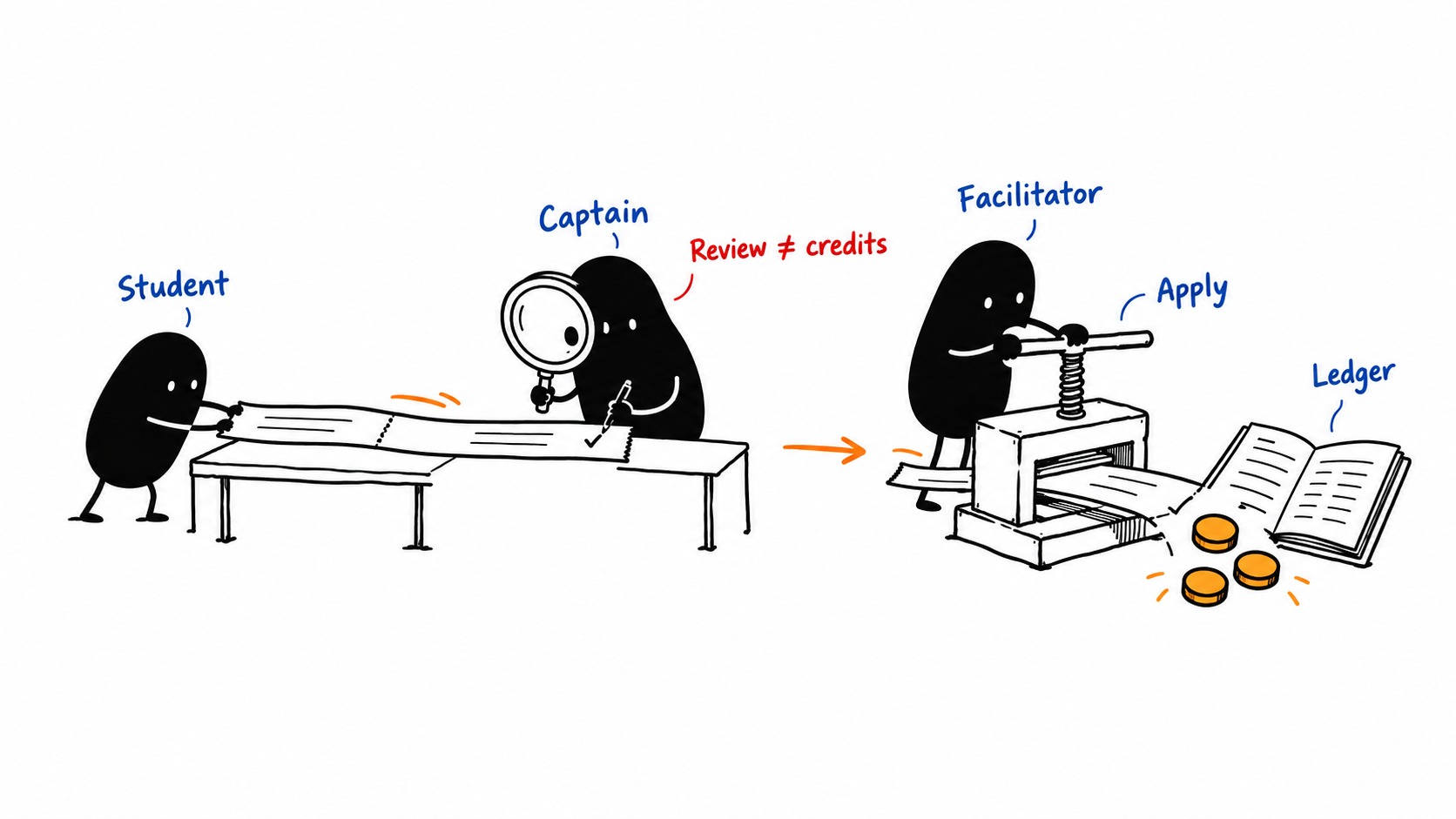
Captains can apply reviewed awards once. Cloud or Not: +100 per correct participant, added to team totals. Recap quizzes: +10 per correct team answer.
NETWORKING 1/3 · 7 min · +100 Cloud Credits / team
Meet the people behind the profiles
- Create or update your LinkedIn profile: name, college, a clear headline and one skill.
- Introduce yourself to your team and one person from another team. Send each other a connection request.
- Scan the QR and send Vishruth a connection request. Add a short note if available: “We met at the ChaiCart workshop. I’m learning ___.”
- Ask a peer about a project or goal. Remember one way you can help them.
Why: Make a useful introduction today; follow up with something helpful after the workshop.
Earn +100: every teammate completes the activity; COO reports completion to the captain. Once per team.
Already have an account? Improve it; existing connections and follows count. Signup delayed? Draft your profile now and finish during a break; ask your captain to record completion. Never share passwords or OTPs.
ICEBREAKER · Stand up = Cloud · Sit = Not cloud
Cloud or Not? 🤔
Answer on your own phone. Each correct answer earns 100 credits for you and adds 100 to your team.
Answers (with twists)
Cloud or Not? — the reveal
| Item | Verdict | Twist |
|---|
| Gmail, Netflix, ChatGPT, Google Photos | ☁️ Cloud | You own nothing but a browser/app. Everything runs in someone else's data centre. |
| UPI payment | ☁️ Cloud-like | Runs on NPCI's own data centres — a private cloud-style platform connecting hundreds of banks and apps via APIs. |
| Excel on your laptop | 🤷 It depends | Local file = not cloud. AutoSave to OneDrive / co-editing = cloud (SaaS). |
| Pen drive, calculator | ❌ Not cloud | Local hardware, no network, no shared pool. |
Lesson: “cloud” is not a place. It's a way of delivering computing.
What is cloud computing?
Computing like electricity ⚡ — you don't build a power plant to switch on a fan
NIST's definition: 5 essential characteristics
🛒
On-demand self-service
Click → server in minutes. No ticket, no waiting.
🌐
Broad network access
Anywhere, any device, over the internet.
🏊
Resource pooling
Many customers share a giant pool of hardware.
🎈
Rapid elasticity
Grow for Diwali, shrink after. Automatically.
🧾
Measured service
Pay per second / GB / request — like a meter.
ACTIVITY · 7 min · +50 credits to the fastest correct team
The Human Timeline 🧍♀️🧍🧍♂️
- Each team gets 12 digital event cards with no years on them
- Discuss the 12 digital cards and arrange them chronologically in ChaiCart Live
- Twist: no talking for the first 2 minutes. Gestures only
- Done? Raise your hands and shout “DEPLOYED!”. Your region captain checks the order
Sample cards
“Docker makes containers easy” · “Amazon launches S3 and EC2” · “India launches UPI” · “ARPANET sends its first message” · “ChatGPT launches”...
Evolution of cloud
60 years in one line
1960sMainframe time-sharing
1969ARPANET
1989World Wide Web
1998VMware – x86 virtualization
1999Salesforce – “No Software”
2006AWS S3 + EC2
2008Google App Engine
2010Microsoft Azure GA
2013Docker
2014Kubernetes
2016UPI launches
2022ChatGPT / GenAI boom
Era 1: Shared big iron
One mainframe, many terminals.
Era 2: Own your servers
Every company runs its own data centre.
Era 3: Rent everything
Utility computing, APIs, AI on tap.
Why businesses move to cloud
Before cloud: 6 weeks to get a server. Now: 60 seconds.
💸
CapEx → OpEx
No big upfront hardware purchase. Pay as you go.
🚀
Speed
Experiment today, launch tomorrow, kill it next week.
📈
Elastic scale
IPL final traffic without buying servers for the other 364 days.
🌏
Global reach
Regions on every continent — go global in a click.
🧠
Innovation on tap
AI, analytics, IoT as ready-made services.
🛡️
Resilience
Multiple data centres & backups by design.
CHAPTER 1
Service Models
IaaS · PaaS · SaaS
aka “How much do you want to cook yourself?”
The analogy
Biryani-as-a-Service 🍛
🏠
On-premises
Cook at home. You buy the stove, gas, rice, masala, cook, serve and wash up.
🔪
IaaS
Rent a fully equipped kitchen. Stove & gas provided — you bring ingredients and cook.
🛵
PaaS
Order from Swiggy. Cooked for you — you provide the table, plates and the party.
🍽️
SaaS
Dine at the restaurant. Just show up, eat and pay.
The further right you go: less control, less effort.
The real stack
Who manages what?
| On-Prem | IaaS | PaaS | SaaS |
|---|
| Applications | You | You | You | Provider |
| Data | You | You | You | Provider* |
| Runtime | You | You | Provider | Provider |
| Middleware | You | You | Provider | Provider |
| Operating system | You | You | Provider | Provider |
| Virtualization | You | Provider | Provider | Provider |
| Servers | You | Provider | Provider | Provider |
| Storage | You | Provider | Provider | Provider |
| Networking | You | Provider | Provider | Provider |
* In SaaS you still own your data, users and access decisions — the provider runs the platform.
ACTIVITY · Sorting Race · 6 min · +50 for most correct
Sort the 20 product cards into IaaS / PaaS / SaaS
IaaS
“We give you raw infrastructure”
PaaS
“You bring code, we run it”
SaaS
“Just log in and use it”
Sort the digital cards in ChaiCart Live. The COO submits your choices; captain checks them. +5 credits per correct card; maximum +100.
Answer key
How did you do?
IaaS
Azure Virtual Machines · AWS EC2 · Google Compute Engine · Azure Blob Storage · DigitalOcean Droplets · Azure Virtual Network
PaaS
Azure App Service · Google App Engine · Heroku · Azure SQL Database · Azure Functions (serverless) · Firebase
SaaS
Gmail · Microsoft 365 · Salesforce · Zoom · Canva · ServiceNow · Workday · Dynatrace
Beyond the big three 🧩
FaaS / Serverless (Azure Functions, AWS Lambda) · CaaS (AKS, EKS, GKE) · DBaaS (Azure SQL, Cosmos DB) · AI-as-a-Service (Azure OpenAI, Bedrock, Vertex AI)
CHAPTER 2
Deployment Models
Public · Private · Hybrid · Multi-Cloud
aka “Where should your app live?”
The analogy
Where should your app live? 🏘️
🏨
Public cloud = Hotel
Shared building, check in instantly, pay per night. AWS, Azure, GCP.
🏡
Private cloud = Own house
Only you live there. Full control, full cost. On-prem OpenStack, VMware, Azure Stack.
🏡+🏨
Hybrid = House + Airbnb
Family stays home; guests go to the Airbnb during the wedding season.
🏨🏨🏨
Multi-cloud = Many hotel chains
Taj for business, OYO for budget trips. Best-of-breed or avoid lock-in.
ACTIVITY · Debate · 15 min · +30 per convincing defence
“Where should they live?” — scenario cards
- Each team draws one scenario card. Three teams share each scenario
- 3 minutes to decide: Public / Private / Hybrid / Multi-cloud
- For each scenario, one team is picked at random for a 60-second defence
- The other two teams with that scenario may challenge with one question
- Consider: compliance, latency, cost, scale, skills, lock-in
Scenarios in the deck
🏦 Large bank · 🏏 OTT cricket startup · 🏥 Hospital chain · 🏛️ State government portal · 🌍 Global e-commerce · 🛡️ Defence lab · 🎉 College fest website · 🚗 Smart car factory
Debrief
There's no single right answer — only trade-offs
⚖️ Regulation
RBI payment-data localisation (2018), India's DPDP Act (2023), sector rules like healthcare & defence.
⚡ Latency
Factory robots and trading need milliseconds → edge / on-prem.
💰 Cost pattern
Spiky → public cloud wins. Flat & predictable → private can be cheaper.
🔒 Lock-in
Multi-cloud reduces dependency but multiplies complexity.
🧑💻 Skills
Do you have people to run a private cloud 24×7?
🏛️ Sovereignty
Government workloads: India's GI Cloud (MeghRaj) & empanelled providers.
CHAPTER 3
Major Cloud Platforms
& who uses them
The landscape
The big players
AWS
Pioneer (2006). Largest market share (~30%). Broadest catalogue.
Netflix · Airbnb · Swiggy
Microsoft Azure
#2 (~20%+). Enterprise & hybrid strength, M365 / Entra ID, Azure OpenAI.
Many banks, manufacturers, government
Google Cloud
#3 (~12%). Data, analytics, Kubernetes birthplace, Vertex AI & TPUs.
Spotify · retail & media
Oracle Cloud (OCI)
Oracle Database powerhouse, price-performance, multicloud DB partnerships.
ERP-heavy enterprises
Also: IBM Cloud, Alibaba Cloud, DigitalOcean, and Indian providers/data-centre players. Market shares are approximate industry estimates.
🇮🇳 All four big players run regions in India (e.g. Mumbai, Pune, Chennai, Hyderabad, Delhi) — important for data residency.
Cloud Rosetta Stone
Same idea, different names
| Need | AWS | Azure | Google Cloud |
|---|
| Virtual machine | EC2 | Virtual Machines | Compute Engine |
| Serverless functions | Lambda | Azure Functions | Cloud Run functions |
| Managed Kubernetes | EKS | AKS | GKE |
| Object storage | S3 | Blob Storage | Cloud Storage |
| Relational DB | RDS / Aurora | Azure SQL / PostgreSQL | Cloud SQL / AlloyDB |
| NoSQL DB | DynamoDB | Cosmos DB | Firestore / Bigtable |
| Monitoring | CloudWatch | Azure Monitor | Cloud Monitoring |
| GenAI platform | Bedrock | Azure OpenAI / AI Foundry | Vertex AI |
ACTIVITY · Cloud Shark Tank · 30 min · Region winners +50 · Grand winner +100
Win ChaiCart's cloud contract
- Each team gets a platform card (AWS, Azure, Google Cloud or OCI) and the client brief
- 8 min to prepare a pitch
- Region round: each team pitches for 1 minute to its region. Teams vote for the best pitch (not their own)
- Grand final: the 4 region winners pitch for 2 minutes on stage, then take one tough question
Judge on
- Fit to the brief: India regions, AI, spikes, budget
- Honesty about weaknesses
- Confidence and creativity
- Best closing line
NETWORKING 2/3 · 7 min · +100 Cloud Credits / team
Build your developer circle
- Create or update your GitHub profile: a short bio, your learning interests and an existing project link if you have one.
- Find your teammates on GitHub. Follow each other and ask what they want to build.
- Scan the QR and follow @theharithsa. Open the ChaiCart workshop repository from the profile.
- Pair up: share one project idea and agree how you could help each other build it.
Why: A profile helps people find you; collaboration gives them a reason to return.
Earn +100: every teammate completes the activity; COO reports completion to the captain. Once per team.
Already have an account? Improve it; existing connections and follows count. Signup delayed? Draft your profile now and finish during a break; ask your captain to record completion. Never share passwords or OTPs.
ENERGIZER · Cloud Bingo · 8 min · First 3 teams +30
Cloud Bingo
One card per team. I read a clue; if the answer is on your card, mark it. Five in a row → the whole team shouts “AUTOSCALE!”
“I store files as objects, practically unlimited.”
→ Blob Storage / S3
“I run your code only when an event happens.”
→ Serverless function
“I spread traffic across servers.”
→ Load balancer
Full caller list is in the printable Cards pack.
CHAPTER 4
Virtualization &
Containerization
Houses, apartments and tiffin boxes
The analogy
🏠 → 🏢 → 🍱
🏠
Bare metal = Independent house
One family (app) per plot. Lots of wasted space. Slow to build.
🏢
Virtual Machine = Apartment
One building (server), many flats. Each flat has its own kitchen (own OS). The builder's structure = hypervisor.
🍱
Container = Tiffin box
Everyone shares one big kitchen (host OS kernel), but each meal is sealed and portable. Light, fast, identical everywhere.
Under the hood
VMs vs Containers
Virtual Machines
Hypervisor (Hyper-V, KVM, VMware ESXi)
Physical server
Strong isolation · GBs in size · boots in minutes
Containers
Container runtime (containerd / Docker)
Host OS (shared kernel)
Server or VM
Lightweight · MBs in size · starts in seconds
🎼 Kubernetes = the orchestra conductor: runs thousands of containers, restarts failures, scales up/down.
LIVE DEMO · Azure
Race: Container vs VM 🏁
🍱 Container (Azure Cloud Shell)
az group create -n rg-chaicart-demo -l centralindia

az container create -g rg-chaicart-demo -n chaicart-hello \
  --image mcr.microsoft.com/azuredocs/aci-helloworld \
  --os-type Linux --cpu 1 --memory 1 \
  --ports 80 --ip-address Public

az container show -g rg-chaicart-demo -n chaicart-hello \
  --query ipAddress.ip -o tsv
🏢 Virtual machine (Portal)
Portal → Create a resource → Virtual Machine → Ubuntu, B1s → Review + create.
Start both at the same time. Audience guesses which one serves a web page first.
🧹 Clean up afterwards:
az group delete -n rg-chaicart-demo --yes
CHAPTER 5
Cloud Architecture
& essential components
The Lego bricks
Essential building blocks
🚚 CDN
Content cached near users
⚖️ Load balancer
Spreads traffic
🛡️ WAF / Firewall
Blocks bad traffic
🚪 API gateway
Front door for APIs
🖥️ Compute
VMs, containers, functions
⚡ Cache
Redis — fast memory
📬 Queue
Absorbs bursts, decouples
🗄️ SQL DB
Orders, payments
📦 NoSQL DB
Menus, sessions
🪣 Object storage
Images, backups
🪪 Identity
Who can do what
🔑 Secrets vault
Keys & passwords
🔭 Observability
Metrics, logs, traces
🗺️ Regions & AZs
Where it all runs
A classic web architecture
How a request travels
📱 User
➜
🌐 DNS
➜
🚚 CDN + WAF
➜
⚖️ Load balancer
➜
🖥️ App servers
AZ-1 · AZ-2 · AZ-3
⚡ Cache
🗄️ SQL DB
primary + replica
📬 Queue ➜ worker
🪣 Object storage
🔭 Monitoring (everything)
Design for failure
Everything fails eventually. Spread across zones.
Scale out, not up
Add more small servers rather than one giant one.
Loose coupling
Queues & APIs so one failure doesn't cascade.
ACTIVITY · Architecture Lego · 25 min · Region best +50 · Overall best +100
Design ChaiCart's architecture
- Use the digital components and architecture builder in ChaiCart Live
- Draw the path of an order: app → … → rider
- Label your cloud provider and region
- Save your architecture in ChaiCart Live. It will be frozen for Day 2.
⚠ PLOT TWIST
🪔 DIWALI MEGA SALE!
Marketing just promised 50× normal traffic tomorrow evening. Your CFO says “no extra budget.”
You have 7 minutes to redesign.
Checklist for judging
Well-Architected in 6 questions
🛡️ Reliability
What happens if one zone dies?
🔒 Security
Where are secrets? Who can access the DB?
💰 Cost
Does it shrink at 3 AM?
⚙️ Operational excellence
How do you deploy & know it's healthy?
🚀 Performance
Cache? CDN? Queue for bursts?
🌱 Sustainability
Are you running idle servers?
Based on the Well-Architected frameworks published by AWS, Azure and Google Cloud.
CHAPTER 6
Cloud-Native &
Microservices
One chef or a whole kitchen?
Monolith vs microservices
👨🍳 One super-chef vs 🧑🍳🧑🍳🧑🍳 a station kitchen
Monolith
- One big app, one codebase, one deployment
- Simple to start ✅
- Chef falls sick → restaurant closes ❌
- Want more dosas? Clone the whole chef ❌
Microservices
- Small services: order, payment, kitchen, delivery, notification
- Each team deploys independently ✅
- Scale only the busy station ✅
- But: many network calls → harder to debug ⚠️
☁️ Cloud-native = containers + microservices + APIs + CI/CD + DevOps + automation, built to run on elastic cloud.
ACTIVITY · The Human Kitchen · 20 min · Volunteers' teams +20
Become microservices
Six volunteers from six different teams come to the front. Everyone else counts, times and cheers.
Round 1 — Monolith (3 min)
ONE volunteer processes every order ticket alone: confirm Order, Payment, Kitchen, Rider and SMS steps in the app. The room counts orders done.
Round 2 — Microservices (3 min)
FIVE volunteers, one station card each. Tickets flow along the line. Each station writes its time on the ticket.
Round 3 — Chaos (3 min)
Mid-round, I tap the Payment person and they freeze. What happens to orders? Who notices? How fast?
Debrief
What did the kitchen teach us?
- Throughput went up — parallelism & independent scaling
- One frozen station blocked everything → need timeouts, retries, fallbacks
- Nobody knew where the order was stuck… until we read the timestamps on the digital token
🔍 That ticket was a distributed trace!
Each station = a span. The ticket number = a trace ID. Hold that thought for the end of today.
CHAPTER 7
Industry Use Cases
& real-world adoption
ACTIVITY · Gallery Walk · 20 min · Best insights +50
Case study gallery walk
Netflix
From DVD-shipping outage to chaos engineering on AWS
Disney+ Hotstar
Record-breaking live cricket streams
UPI / NPCI
Billions of payments a month
IRCTC Tatkal
The 10 AM stampede
Capital One
A bank goes all-in on public cloud
Spotify
From own data centres to Google Cloud
Read the six digital case studies in ChaiCart Live. Move to the next case every 3 minutes. Save reflections answering “Which cloud concept saved them?” and “What would ChaiCart copy?”
CHAPTER 8
Cloud Observability
& Monitoring — a first look
The doctor analogy 🩺
How do you know your app is healthy?
📈
Metrics = Vital signs
Pulse, BP, temperature → CPU, response time, error rate, orders/min. Numbers over time.
📓
Logs = Patient's diary
“09:02 felt dizzy after lunch” → 09:02 ERROR payment timeout. Detailed events.
🩻
Traces = MRI scan
Follows one request through every organ (service) and shows exactly where it got stuck.
Monitoring tells you that something is wrong. Observability lets you ask why — even for problems you never predicted.
LIVE DEMO · Dynatrace
A 5-minute peek into a real observability platform
- 🗺️ Service map — see how microservices talk to each other
- 📈 Metrics — response time & failure rate of a service
- 🧵 A distributed trace — the “order ticket” of a real request
- 🚨 Problems — AI grouping alerts into one root cause
Ask the audience
“If ChaiCart's payments were failing right now, which of these screens would you open first — and why?”
QUIZ · 10 questions · +10 per correct answer
Day 1 recap quiz
- The COO submits the team's answer (A–D) in ChaiCart Live
- 20 seconds per question. No changing answers after the reveal
- The facilitator locks each question and applies +10 per correct answer. Check your team ledger at the end.
Open live quiz controls · Leaderboard
Before you leave…
ChaiCart launches tomorrow at 9:00 AM.
Something WILL break.
DO NOT OPEN
Your incident evidence unlocks in ChaiCart Live on Day 2. Keep your saved architecture ready. 🕵️